

Knowing how to value a business accurately can make the difference between a profitable investment and a costly mistake. Business valuation is the process of determining what a company is worth, whether you’re planning to sell, merge, apply for a loan, or offer employees equity. In fact, this critical financial assessment uses several methods to arrive at a fair market value.
While market capitalization remains a common approach for public companies like Microsoft—which had trading at $515.74 as of October 2, 2025—private businesses require different valuation techniques. For instance, discounted cash flow analysis is considered the gold standard of valuation, although small businesses that generate less than $1 million typically sell for less than twice their EBIT. Furthermore, the appropriate valuation method varies depending on the company size, industry, and purpose of the assessment.7.43 billion shares outstanding
This comprehensive guide explores the most effective business valuation methods for 2025, explaining when to use each approach and how to apply them correctly. Whether you’re valuing a company for purchase or preparing your business for sale, these expert techniques will help you determine a fair and defensible valuation. For complex transactions or contested valuations, forensic accounting services provide an additional layer of analytical rigor.
Why trust this guidance: This guide is authored under the oversight of Joey Friedman, CPA, PA, a Florida-licensed Certified Public Accountant and Accredited Business Valuator with extensive experience providing business valuation services to closely held businesses across Florida and nationwide. Joey Friedman CPA PA regularly performs valuations for sale transactions, buy-sell agreement valuations, litigation support, and tax reporting—applying IRS-compliant methodologies and AICPA valuation standards to every engagement.
Getting Ready to Value a Business
Before diving into complex formulas, proper preparation creates the foundation for an accurate business valuation. Taking methodical steps at this stage saves time and ensures more reliable results down the road.
Organize financial documents
The cornerstone of any business valuation is comprehensive financial documentation. Most valuation professionals require at least three to five years of financial records[1]. This typically includes:
- Tax returns for the previous 3-5 years
- Profit and loss statements (P&Ls)
- Balance sheets
- Cash flow statements
- Customer and supplier information
- Growth rate documentation for revenue streams
Consistency matters—ensure your financial statements use the same accounting policies throughout [2]. Additionally, for complex organizations, gathering all necessary documentation might take several months, so starting early is advisable.
Understand your assets and liabilities
A thorough business valuation analyzes all aspects of a company’s finances, assets, and liabilities to determine its economic value [4]. Prior to valuation, take time to reconcile your assets and liabilities, ensuring all balances accurately reflect reality [2].
Identify any non-operating assets (such as excess cash or investments) that aren’t essential to the core business [2]. These might be valued separately. Similarly, intellectual property often represents significant value—verify you legally own all IP and have taken steps to protect it [5].
Most importantly, ensure your capitalization table is accurate and up-to-date [5]. This document shows ownership percentages and will be meticulously examined during valuation processes.
Clarify the purpose of valuation
Your specific goals should drive the type of business valuation you choose [1]. Common valuation purposes include:
Seeking a buyer, estate planning, management restructuring, or securing financing [1]. The valuation method appropriate for tax purposes might differ from one used for selling to an external party.
An incorrect estimate could negatively impact both business and personal long-term financial strategies [4]. Consequently, understanding your specific purpose helps determine which valuation approach will provide the most relevant results.
Key Valuation Metrics and Terms
Image Source: eFinancial Models
“What publicly-traded companies are worth is roughly 90% dominated by the cash flows they produce over time and 10% by what the market will pay for these types of companies at any given time.” — Tom Gayner, CEO of Markel Corporation; respected value investor
Understanding financial metrics is essential when determining what a business is truly worth. These valuation measurements serve as the foundation for applying various valuation methods effectively. (SDE)
Seller’s Discretionary Earnings
Seller’s Discretionary Earnings represents the total financial benefit one full-time owner-operator would receive annually from a business [6]. This metric is especially valuable for small businesses where owners actively participate in operations. SDE calculations start with pre-tax net income, then add back the owner’s compensation, interest expenses, depreciation, amortization, discretionary expenses, and non-recurring costs [7]. This comprehensive approach provides potential buyers with a clearer picture of expected returns after acquisition.
EBITDA vs. SDE
The primary difference between these metrics involves owner compensation. EBITDA (Earnings Before Interest, Taxes, Depreciation and Amortization) excludes owner’s salary, whereas SDE includes it [8]. This distinction makes EBITDA more appropriate for larger businesses with professional management structures. Generally, businesses with less than $1 million in SDE typically use the SDE metric, while companies exceeding this threshold use EBITDA [8]. The calculation difference reflects the reality that small business buyers often replace the owner, keeping their compensation, while mid-sized business buyers typically hire managers.
SDE and EBITDA multiples
Multiples transform these earnings metrics into business valuations. from 1.5x to 3.0x for small businesses SDE multiples typically range[9]. Conversely, EBITDA multiples tend to be higher—usually 3x to 5x—precisely because they exclude owner compensation [9]. For instance, at a 2.1x multiple, a business generating $400,000 in SDE would be valued at $840,000 [9]. Moreover, as businesses grow, their multiples often increase, with companies earning $1-2 million in EBITDA potentially commanding 3-6x multiples [10].
Enterprise value vs. equity value
Enterprise value represents a company’s total worth, including both debt and equity components, while equity value reflects only what belongs to shareholders [11]. To illustrate this difference, consider a house analogy: if you purchase a $500,000 home with a $100,000 down payment and a $400,000 mortgage, the enterprise value is $500,000 (total house value), while the equity value is just $100,000 (your ownership stake) [12]. The formula relationship is straightforward: Equity Value = Enterprise Value – Total Debt + Cash [11]. This distinction becomes crucial during acquisitions, as enterprise value makes companies more comparable by removing capital structure considerations from the equation.
Top 6 Valuation Methods That Work in 2025
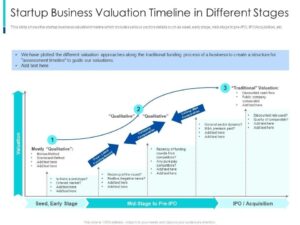
Image Source: SlideTeam
Selecting the right valuation method is crucial for accurately determining what a business is worth in today’s market. Each approach offers unique insights into a company’s true value.
1. (DCF)Discounted Cash Flow
The DCF method calculates a company’s value based on projected future cash flows discounted back to present value using a discount rate. This approach works best for mature, stable businesses with predictable cash flows [13]. The formula involves forecasting cash flows for 5+ years and then applying a discount rate—often the weighted average cost of capital (WACC)—to account for the time value of money [14]. DCF is considered highly intrinsic yet requires accurate projections, making it ideal for businesses with steady revenue streams rather than volatile startups [15].
This method determines a company’s value by dividing normalized earnings by a capitalization rate [1]. Unlike DCF, which projects varying cash flows, capitalization of earnings assumes steady growth into perpetuity [5]. The formula is straightforward: Business Value = Earnings / Capitalization Rate. Small businesses typically use capitalization rates between 20-25%, reflecting the return on investment buyers expect [1]. This approach works particularly well for established businesses with stable earnings histories.
3. Adjusted Net Asset Method
The adjusted net asset method revalues a company’s assets and liabilities to reflect current fair market values rather than book values [16]. This approach involves identifying all assets and liabilities, revaluing them to current market values, then calculating the difference [17]. It’s particularly suitable for holding companies, capital-intensive businesses, or companies generating continuous losses [16]. The adjusted book value represents the difference between total fair market value of adjusted assets and liabilities [16].
4. Market Approach (Comparable Sales)
This method values a business based on recent sales of similar companies [18]. It requires finding comparable businesses and applying appropriate adjustments for differences in size, growth rates, and market position [2]. The market approach uses two primary methods: Comparable Company Analysis (CCA) and Precedent Transaction Analysis (PTA) [2]. This approach provides real-world perspectives on valuation but requires sufficient data on similar transactions to be effective [18].
5. EBITDA Multiple Method
EBITDA multiples are widely used to determine enterprise value, especially for comparing companies within the same industry [19]. The formula divides a company’s Enterprise Value by its EBITDA [20]. Multiples vary by industry and company size—smaller businesses with EBITDA between $1-10 million typically command multiples ranging from 4.0x to 6.5x [21]. High-growth sectors like technology and healthcare often receive higher multiples than traditional industries like construction [21].
6. Book Value Method
This straightforward method calculates a company’s worth by subtracting total liabilities from total assets [22]. It essentially represents what shareholders would receive if all assets were liquidated and debts paid [22]. Book value equals the shareholder equity listed in the bottom right corner of a balance sheet [22]. Although simple to calculate, book value doesn’t consider future earnings potential or intangible assets’ value [23]. It’s most effective for asset-heavy businesses or as a “floor value” in negotiations [24].
How to Choose the Best Method for Your Business
“Value to some extent is in the eye of the beholder. It is very hard to pin down what the value of a future set of cash flows from a business, be it cable TV or biotechnology, is going to be.” — Seth Klarman, CEO and Portfolio Manager of The Baupost Group; influential value investor and author
Choosing an appropriate valuation approach requires understanding the specific circumstances of your business and the purpose of your valuation. The right method creates a defensible value that aligns with your objectives.Valuing a small business vs. large company
Size significantly impacts which valuation methodology works best. Small businesses typically operate with less formal documentation, greater owner dependence, and less predictable cash flow, all of which reduce their overall value. Conversely, larger companies benefit from more predictable revenue streams and self-sufficient documentation, enhancing their worth.
Small businesses often rely on the Seller’s Discretionary Earnings (SDE) method, while larger enterprises typically use EBITDA-based approaches [26]. Key factors affecting small business valuations include:
- Owner involvement – Heavy reliance on the owner can decrease value due to transferability risks
- Revenue diversity – Businesses with only one or two major clients are considered riskier
- Market competition – The presence or absence of direct competitors influences value
Investors naturally require higher returns from smaller companies to offset increased risk levels, directly affecting valuation multiples [27].
How to value a business for purchase or sale
The transaction purpose often dictates the most appropriate valuation method. For selling a business, combining income and market-based approaches typically provides the most complete picture [28]. Merger and acquisition scenarios frequently benefit from market-based methods that align with industry transaction patterns [26].
Buyers should understand various valuation techniques to negotiate effectively and avoid overpaying. Actually, the most accurate assessments often come from using multiple valuation approaches simultaneously. Subsequently, this hybrid methodology creates a more realistic picture, particularly when assessing small to medium-sized businesses.
When to use professional help
depending on complexity Professional valuation services generally cost between $6,000 and $20,000[4]. Hence, while a DIY approach might work for smaller businesses with straightforward operations, medium to larger enterprises with complex structures benefit from professional assistance [29].
Qualified appraisers, often called business valuation experts, are usually CPAs who hold certifications like the Accreditation in Business Valuation (ABV) from the prestigious and respected AICPA organization. These accredited experts follow established standards like the Uniform Standards of Professional Appraisal Practice (USPAP) [4]. They provide several advantages, primarily objectivity and specialized expertise in selecting the most appropriate valuation methods [30]. Additionally, professional valuations offer stronger defensibility if challenged during litigation, tax proceedings, or financing negotiations [30].
Regardless of business size, professional help becomes essential for high-stakes transactions where precision matters most.
Conclusion
Business valuation remains both an art and a science, requiring careful consideration of multiple factors to arrive at an accurate assessment. Throughout this guide, we’ve explored various methods that effectively determine what a business is truly worth in 2025’s economic landscape.
Valuing a business correctly starts with thorough preparation—gathering comprehensive financial documentation, understanding assets and liabilities, and clarifying the specific purpose behind your valuation. This groundwork proves essential regardless of which valuation method you ultimately choose.
Different businesses demand different valuation approaches. Small businesses typically benefit from SDE-based methods that account for owner involvement, while larger enterprises generally rely on EBITDA multiples or discounted cash flow analysis. The industry, growth stage, and financial stability likewise influence which technique will yield the most accurate results.
Most professionals agree that using multiple valuation methods simultaneously creates the most realistic picture. DCF might serve as your primary approach, but supplementing it with market comparables or adjusted asset valuations provides valuable perspective and validation.
Ultimately, business valuation goes beyond mathematical formulas. It requires judgment, industry knowledge, and careful analysis of both tangible and intangible factors. Companies with predictable cash flows, diversified revenue streams, and minimal owner dependence naturally command higher valuations than those facing uncertain futures or heavy reliance on key individuals.
Professional help becomes particularly valuable for complex valuations or high-stakes transactions. Though professional services cost between $6,000 and $20,000, their expertise often justifies the investment, especially when defensibility matters.
Whether you plan to sell your business, acquire one, or simply understand your company’s current worth, these valuation methods provide a structured framework to make informed decisions. The right valuation approach, applied correctly, transforms uncertainty into actionable business intelligence—a crucial advantage in today’s competitive marketplace.
Key Takeaways
Master these proven business valuation methods to make informed decisions whether buying, selling, or assessing your company’s worth in 2025’s competitive market.
- Prepare thoroughly first: Gather 3-5 years of financial records, organize assets/liabilities, and clarify your valuation purpose before applying any method.
- Match method to business size: Small businesses use SDE multiples (1.5x-3.0x), while larger companies rely on EBITDA multiples (3x-5x) or DCF analysis.
- Use multiple approaches: Combine income-based methods like DCF with market comparables to create the most accurate and defensible valuation.
- Consider professional help for complex deals: While DIY works for simple valuations, professional services ($6,000-$20,000) provide expertise and defensibility for high-stakes transactions.
- Understand key value drivers: Predictable cash flows, diversified revenue streams, and minimal owner dependence significantly increase business valuations across all methods.
The most successful valuations balance mathematical precision with industry knowledge, recognizing that business worth extends beyond formulas to include market conditions, growth potential, and operational stability.
Frequently Asked Questions
What are the most effective methods for valuing a business?
The most effective methods for how to value a business include Discounted Cash Flow (DCF), Capitalization of Earnings, Adjusted Net Asset Method, Market Approach (Comparable Sales), EBITDA Multiple Method, and Book Value Method. The right choice depends on business size, industry, and purpose of the assessment.
How does the valuation process differ for small businesses versus large companies?
Small businesses typically use the Seller’s Discretionary Earnings (SDE) method with multiples ranging from 1.5x to 3.0x, while larger companies often rely on EBITDA-based approaches with multiples of 3x to 5x. Small businesses are more affected by owner involvement and revenue concentration, whereas larger companies benefit from more predictable cash flows and established management structures.
What financial documents are essential for an accurate business valuation?
Essential financial documents include tax returns for the previous 3–5 years, profit and loss statements, balance sheets, cash flow statements, customer and supplier information, and growth rate documentation. Consistency in accounting policies across all documents is critical for a defensible valuation.
When should a business owner hire a professional valuation service?
Consider professional valuation services for complex transactions, litigation, tax proceedings, or financing negotiations. Per The Appraisal Foundation, valuations conducted under recognized professional standards—such as USPAP—are especially important when selling, transferring, or litigating a business interest. Professional services typically cost between $6,000 and $20,000 depending on complexity.
How can a business owner increase their company’s value before a valuation?
Focus on diversifying revenue streams, reducing owner dependence, improving cash flow predictability, and strengthening market position. Ensure financial records are accurate and current, protect intellectual property, and demonstrate consistent growth trends. These steps reduce diligence friction and typically result in higher valuation multiples.
What IRS standards apply to business valuations?
The IRS uses Revenue Ruling 59-60 as the foundational standard for valuing closely held business interests for tax purposes. It outlines eight factors including earnings capacity, dividend-paying capacity, book value, and financial condition. Valuations used in estate planning, gifting, or corporate transactions should comply with these IRS guidelines to withstand audit scrutiny.
Contact the team at Joey Friedman CPA PA for a confidential consultation to discuss your business valuation needs for transactions, negotiations, disputes, or investigations. The firm serves clients nationwide.
Disclaimer: This article is for informational purposes only and does not constitute legal advice. Outcomes depend on specific facts and circumstances.