
Expert financial analysis requires a deep understanding of a forensic accountant’s role in legal disputes. These professionals excel at examining financial evidence and make complex transactions clear to non-technical people. Their expertise extends to both criminal and civil matters. The work shares some similarities with forensic economists, but each brings unique investigative approaches to the table.
A forensic economist’s testimony can impact case outcomes by a lot. They break down economic theories in legal settings and use statistical tools to resolve complex financial disputes. Forensic accountants possess most of these same capabilities. Both groups testify as experts in litigation disputes and analyze economic damages. A forensic accountant’s work involves reviewing financial statements, tax returns, general ledgers, and forecasts to create detailed financial pictures. The forensic economist’s focus stays on damage assessment through earnings history, work-life expectancy, and benefit analysis.
Your case’s specific needs should guide the choice between these specialists. Forensic economists receive specialized training in complex economic calculations like present value. Forensic accountants offer strong investigative skills in financial matters of all types. The right expert for your legal and financial needs depends on understanding these differences and overlaps.
What Does a Forensic Accountant Do?

Image Source: LinkedIn
Forensic accountants work as financial detectives to solve legal puzzles. They blend their expertise in accounting with investigative skills to spot financial irregularities and provide expert analysis in legal cases.
Core Responsibilities: Fraud Detection, Compliance, and Financial Tracing
A forensic accountant’s main job is to uncover financial wrongdoing through detailed analysis. They and help recover assets while analyzing financial data trace funds through forensic research[1]. These financial investigators create detailed reports and give testimony in legal proceedings when needed.
These specialists excel at spotting fraud schemes and proving them through proven methods [2]. They can quickly identify financial issues from complaints and claims. Their job involves looking through financial records to find signs of fraud or embezzlement. They stay objective in their analysis instead of taking sides [3].
A vital part of their work is —following money trails whatever path they take fund tracing[4]. Forensic accountants use specific methods like the Lowest Intermediate Balance Rule to rebuild financial transactions and expose fraud [5]. They also suggest useful steps to stop fraud from happening again [2].
Tools Used: Financial Statements, Tax Records, and Internal Controls
These professionals use specialized tools to find and interpret financial evidence. Software like Interactive Data Extraction and Analysis (IDEA) and ACL Analytics help them work with big datasets. These tools scan thousands of transactions to find unusual patterns that might point to fraud [6].
They look through financial statements, tax returns, and bank records to find hidden assets or unusual items [7]. By comparing financial ratios to industry averages, they spot oddities that could mean fraud [8]. They also use Benford’s Law—a statistical method that looks at number patterns—to catch manipulated figures [8].
Digital forensic tools now play a key role in financial investigations [2]. EnCase and Forensic Toolkit help recover deleted files and check electronic messages that might contain hidden evidence [6].
Common Case Types: Embezzlement, Divorce, and Business Disputes
These specialists handle many types of cases. The Sandhogs Union pension fund case shows how they trace funds to prove theft [9]. In fraud cases, they carefully review records to spot irregularities and rebuild money trails [10].
During divorces, they find hidden assets, check income claims, and help split property fairly [7]. They search through financial accounts, tax returns, IRS data, and credit reports to find undisclosed accounts and investments [7]. They also value businesses and separate personal finances from business ones [11].
In business disputes, these professionals analyze records to help reach solutions [12]. They figure out damages and cooperate with attorneys to present evidence [12]. As expert witnesses, they explain complex financial matters in simple terms [13].
These specialists can do most tasks that forensic economists do, including calculating economic damages in personal injury cases, business disputes, and contract breaches [14].
What is Forensic Economics and How Does It Differ?
Forensic economics combines economic theories with legal frameworks to calculate monetary damages and analyze liability claims. The National Association of Forensic Economics describes it as “the scientific discipline that applies economic theories and methods to the issue of pecuniary damages as specified by case law and legislative codes” [15].
Economic Modeling: Labor Trends, Inflation, and Present Value
Forensic economists employ sophisticated economic models to review damages. Their work includes analyzing labor market trends, inflation rates, and present value calculations. These experts study wage growth patterns and apply discount rates to determine current worth of future losses. The formula Present Value = F/(1+r)^n helps translate future financial losses into today’s dollars, where F represents future cash flows, r shows the discount rate, and n indicates the number of years [16].
Calculating appropriate discount rates remains crucial. Many economists look at average historical returns on investments. These range from Treasury bills (considered “risk-free”) at 0.73% to large company stocks at 6.01%[1]. The choice of discount rate significantly affects damage calculations. For similar 30-year future losses, present values can vary from $26,855 to just $13,750 [1].
Data Sources: Government Surveys vs. Internal Financial Records
Forensic economists rely heavily on government-produced economic statistics, unlike forensic accountants who analyze internal financial records. They regularly check data from the Bureau of Labor Statistics for inflation and earnings growth. The Census Bureau provides construction and income statistics, while the Centers for Disease Control offer life expectancy data. Treasury Department statistics help determine interest rates [17].
Risk probabilities for disability and unemployment come from the Current Population Survey published by the Census Bureau and Bureau of Labor Statistics[2]. These external data sources are the foundations of economic projections that shape damage calculations.
Scope of Analysis: Future Projections vs. Historical Transactions
Forensic economists and accountants differ mainly in their analytical scope. Economists focus on forecasting and determining present values of future income streams, benefits, household services, and medical costs [18]. Accountants spend more time reconstructing historical transactions and tracking past financial activities.
Forensic accountants can handle most tasks that economists do, including economic damage calculations for personal injury, wrongful death, and business disputes. Both groups testify as expert witnesses in litigation with different approaches. Economists highlight market-wide economic trends and statistical models. Accountants’ specialized skills in financial forensics work better for complex financial cases.
Overlap Between Forensic Accountants and Economists
Professional boundaries between forensic accountants and economists often blur, creating significant overlap in their services. Their backgrounds, education, training, and experience show , which lets them handle each other’s traditional responsibilities substantial crossover[18].
Shared Skills: Damage Calculations and Litigation Support
Both professionals excel at calculating economic damages in legal cases. Forensic accountants use systematic methods to determine lost profits. They analyze business models, establish affected time periods, and calculate net sales lost [19]. Forensic economists also estimate damages through discount rates and present value calculations. So, forensic accountants can handle most tasks that forensic economists do [20], including economic damage calculations for cases of all types.
These specialists share expertise in litigation support too. They help attorneys research complex financial issues, prepare for depositions, and develop trial strategies [21]. They work together with legal teams to build strong arguments based on financial evidence and make technical concepts easier to understand.
Expert Witness Roles in Court: Explaining Financial Evidence
Both professionals serve as expert witnesses in court, though their methods might differ slightly. Forensic accountants carefully examine financial records to spot irregularities. They present their findings in ways that judges and juries can understand [22]. Their credibility comes from detailed analysis of financial data that follows industry standards.
Forensic accountants help bridge the gap between complex financial ideas and legal professionals by making financial jargon available to everyone [22]. This skill is a great way to get your point across during testimony, as it will give a clear picture of financial aspects to all parties involved.
When a Forensic Accountant Can Replace an Economist
Hiring a forensic accountant is often for litigation support and damages calculation preferable[20]. A forensic accountant can handle economic damage calculations well unless the case needs highly specialized economic modeling. Their versatility becomes valuable when cases need both historical financial reconstruction and future projections.
Complex cases might need a team approach. All the same, forensic accountants bring practical business knowledge alongside their accounting expertise, which makes them effective at calculating lost economic potential [23].
Case Applications: Who to Hire and When
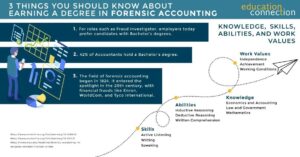
Image Source: Education Connection
The choice between a forensic accountant and economist depends on your legal case’s nature. Forensic accountants can handle most tasks that economists do. They also bring specialized financial investigation skills to the table.
Personal Injury and Wrongful Death: Lost Wages andLife Care Costs
Life care costs are the biggest part of economic damages in catastrophic injury cases. These costs can reach millions of dollars over a lifetime [8]. Forensic accountants know how to measure these expenses. They look at life care plans that detail nursing care, therapies, and equipment needs. They calculate lost wages by looking at past earnings and career growth potential. When dealing with wrongful death cases, they figure out “” – money the deceased person would have saved if they lived their expected lifespan net accumulations[24]. They also review lost support to survivors. This includes both money and other contributions that would have helped family members.
Business Valuation and Lost Profits: Forecasting vs. Reconstruction
Forensic accountants use special methods to calculate damages in business disputes accurately. They clean up financial records by removing one-time or optional expenses [25]. For lost profit cases, they use different approaches. The “Before and After” method compares business performance before and after the damaging event. The “Yardstick” method looks at similar businesses that weren’t affected [26]. Their expertise covers intellectual property disputes, contract breaches, and business interruption claims where exact financial reconstruction matters.
Fraud Investigations: Tracing Funds and Identifying Irregularities
Forensic accountants are great at following complex money trails. They use advanced tracing methods like LIFO (Last-In, First-Out), FIFO (First-In, First-Out), and LIBR (Lowest Intermediate Balance Rule) to separate tainted funds from clean ones [27]. This helps them uncover embezzlement schemes, shell companies, and hidden assets [28]. They combine accounting principles with forensic techniques to spot financial irregularities others might miss [29].
Why Forensic Accounting is Often the Better Choice
Forensic accountants provide complete financial expertise that goes beyond the capabilities of forensic economists. Their broad skill set makes them the best choice to handle complex financial disputes and investigations.
Versatility in Legal Cases: From Tax to Economic Damages
Forensic accountants excel in various legal scenarios—from tax disputes to complex financial fraud investigations. Their complete skill set helps counsel throughout litigation. They identify key documents for damage models and develop thorough analyzes backed by sound economic and financial theories [9]. They help prove that damages were foreseeable and can be quantified with reasonable certainty. These professionals prepare expert reports, testify in depositions, and support counsel during opposing experts’ testimony [9].
Cost-Effectiveness and Availability of Forensic CPAs
Early involvement of forensic accountants in litigation saves money. This approach makes discovery processes quicker and reduces costs over time [5]. These professionals identify essential financial information and organize documentation effectively to cut down billable hours on unnecessary tasks. Their early engagement also helps gather stronger, more relevant evidence that leads to better outcomes [5]. Forensic audits can , so having an in-house accountant with forensic skills cuts external auditing expenses range from $5,000 to $10,000[4].
Ground Experience in Financial Forensics
Forensic accountants’ practical investigative expertise combines accounting principles with detective work. Their specialized training to analyze financial statements and uncover fraud, money laundering, and other financial crimes is invaluable [30]. Of course, knowing how to explain complex financial concepts clearly makes them effective in court settings [31]. As Chancellor Gordon Brown once noted, “financial information and forensic accounting has come to be available” one of today’s most powerful investigative and intelligence tools[32].
Comparison Table
Comparison: Forensic Accountants vs. Forensic Economists
| Aspect | Forensic Accountants | Forensic Economists |
| Main Goal | – Financial investigations & fraud detection- Historical transaction analysis- Fraud & embezzlement cases- Complete financial picture building | – Economic theory application- Future value projections- Present value calculations- Labor market analysis |
| Data Sources | – Financial statements- Tax returns- General ledgers- Internal financial records- Bank statements | – Government surveys- Bureau of Labor Statistics- Census Bureau data- Treasury Department rates |
| Key Tools | – Data analysis software (IDEA, ACL)- Digital forensic tools (EnCase)- Benford’s Law analysis- Financial ratio analysis | – Economic modeling- Statistical tools- Present value formulas- Discount rate calculations |
| Common Cases | – Fraud investigations- Embezzlement- Divorce proceedings- Business disputes- Economic damage calculations | – Personal injury- Wrongful death- Labor disputes- Economic damage assessments |
| Special Capabilities | – Can handle most tasks of forensic economists- Fund tracing- Asset recovery- Fraud detection- Internal controls assessment | – Economic forecasting- Labor trend analysis- Inflation effect assessment |
| Expert Witness Role | – Complete case analysis- Clear explanation of complex finances- Evidence-based testimony- Fraud detection expertise | – Economic theory testimony- Statistical analysis presentation- Future projection explanations |
Note: Forensic accountants can handle most work that forensic economists traditionally do. This makes them a better match for many legal and financial matters.
Conclusion
Forensic accounting and economics have clear differences as specialized financial disciplines. Forensic accountants work as financial detectives who excel at investigating past transactions, uncovering fraud, and following complex money trails. Forensic economists, on the other hand, focus on economic forecasting, labor trend analysis, and complex present value calculations.
Forensic accountants’ versatility lets them handle most tasks that forensic economists typically do. Their complete skill set includes everything from fraud detection to economic damage calculations in cases of all types—including personal injury, wrongful death, and business disputes. This adaptability makes them valuable expert witnesses in court. They know how to explain complex financial concepts in ways that judges and juries understand.
A forensic accountant’s value becomes clear when you look at their investigative skills combined with economic analysis expertise. They offer economical solutions by removing the need to hire multiple specialists and streamline the litigation process. Their unique mix of accounting principles and detective work gives attorneys complete financial expertise that is a big deal as it means that what forensic economists alone can provide.
Your specific case requirements determine which professional you should choose. In spite of that, forensic accountants are usually the better option for most financial disputes because of their wider skill range and practical business knowledge. A qualified forensic accountant will give you a full picture of financial analysis with the economic point of view needed for accurate damage calculations, unless your case needs highly specialized economic modeling way beyond the reach and influence of accounting expertise.
Complex financial litigation needs expert analysis. Think over the extensive capabilities that forensic accountants bring to the table. Their expertise in both detailed financial investigations and economic projections is a vital advantage in legal proceedings where deep financial understanding leads to successful outcomes.
Key Takeaways
Understanding the roles of forensic accountants versus forensic economists can help you choose the right financial expert for your legal case needs.
- Forensic accountants are financial detectives who investigate fraud, trace money trails, and analyze historical transactions using specialized tools like data analysis software and digital forensics.
- Forensic economists focus on future projections using economic models, government data, and statistical analysis to calculate present values and assess labor market trends.
- Forensic accountants can perform most economist tasks including economic damage calculations, making them more versatile for personal injury, business disputes, and fraud investigations.
- Choose forensic accountants for comprehensive cases requiring both historical financial reconstruction and economic projections, as they offer cost-effective, all-in-one expertise.
- Both serve as expert witnesses but forensic accountants bring practical investigative skills that translate complex financial evidence into clear, understandable testimony for courts.
The key advantage of forensic accountants lies in their dual capability to conduct thorough financial investigations while also handling economic analysis—essentially providing two specialties in one expert. This versatility makes them particularly valuable in complex litigation where understanding both past financial activities and future economic impacts is crucial for building a strong case.
FAQs
Q1. What are the key distinctions between forensic accountants and forensic economists? Forensic accountants specialize in investigating financial records, detecting fraud, and tracing complex money trails. They analyze historical transactions and build comprehensive financial pictures. In contrast, forensic economists focus on applying economic theories, forecasting future trends, and calculating present values using statistical models and government data.
Q2. What are the primary responsibilities of a forensic accountant? The core duties of a forensic accountant involve uncovering financial wrongdoing through meticulous analysis of financial statements, tax records, and internal controls. They trace funds, identify assets for recovery, and prepare detailed reports on their findings. Additionally, they investigate fraud schemes, recommend preventive measures, and provide expert testimony in legal proceedings.
Q3. In what types of cases are forensic accountants typically involved? Forensic accountants handle a diverse range of cases, including fraud investigations, embezzlement cases, divorce proceedings, and business disputes. They are skilled in identifying hidden assets, verifying income claims, valuing businesses, and distinguishing between personal and business finances. Their expertise is invaluable in calculating economic damages across various scenarios.
Q4. When is it preferable to hire a forensic accountant over a forensic economist? Unless a case requires highly specialized economic modeling beyond the scope of accounting expertise, hiring a forensic accountant is often preferable. They can competently handle economic damage calculations while also providing specialized financial investigation skills. Their versatility becomes especially valuable in complex matters requiring both historical financial reconstruction and future projections.
Q5. What are the key advantages of engaging a forensic accountant? Forensic accountants offer cost-effective solutions by eliminating the need for multiple specialists. Their unique blend of accounting principles and detective work provides comprehensive financial expertise. They excel at translating complex concepts into clear, understandable terms during testimony. Additionally, their practical business knowledge and real-world experience in financial forensics make them particularly effective in litigation settings.