Working With Your Economic Damage Expert to Build an Objective, Unbiased, Persuasive Story for the Jury
Executive Summary
In economic damage cases, the numbers are only half the battle. The other half is whether the fact-finder believes the damages model is grounded in real-world evidence, neutral assumptions, and transparent math. Effective testimony preparation is not about “selling” an outcome—it is about presenting a coherent, objective story that ties liability facts to financial proof and survives cross-examination. That work is usually a collaboration among counsel, the client, and the damages expert: aligning the case theory with the damages period, selecting methods that fit the available records, testing reasonable alternatives, and packaging the analysis in a way a jury can follow. This article explains when testimony preparation becomes critical, the accepted frameworks experts use, the document set that drives reliable opinions, and the most common pitfalls opposing experts exploit.
When This Issue Arises
Testimony preparation tends to matter most when:
• The damages model depends on forecasts, counterfactual “but-for” assumptions, or disputed causation.• The opposing side will argue mitigation failures, alternative causes, or overstatement of the damages period.• The client’s records are incomplete, inconsistent, or require normalization/adjustments to be meaningful.• The fact pattern is emotional or narrative-heavy (employment disputes, wrongful termination, reputational harm), increasing the risk that financial testimony becomes confusing or distrusted.• The case will be tried to a jury (or prepared as if it will be), where clarity and credibility often drive outcomes.
Common dispute contexts
• Breach of contract and business interruption (lost profits, extra costs, delay damages)• Shareholder disputes (buy-outs, freeze-outs, lost distributions, valuation-driven damages)• Employment disputes (back pay, front pay, benefits, mitigation)• Intellectual property and unfair competition (diversion, erosion, reasonable royalty components)• Tort claims where economic loss must be isolated from non-economic components
Accepted Methods and Testimony Preparation Frameworks
Economic damages experts generally start with a disciplined workflow: define the damages theory, select a method consistent with that theory, build the model from reliable data, and then stress-test the result. For testimony readiness, the focus expands to include how the expert will explain assumptions, tie numbers to exhibits, and demonstrate that the approach is repeatable and unbiased.
Method selection should track the liability theory
A damages model should be consistent with the case narrative. If the theory is “lost opportunity,” the model may require a counterfactual growth path supported by benchmarks. If the theory is “temporary interruption,” a before-and-after approach may be more defensible. If the claim is “diminution in value,” valuation-based techniques and discounting logic typically take center stage. Misalignment between liability and method is one of the fastest ways to lose credibility.
Transparency and sensitivity testing are not optional
Opposing experts frequently attack damages by challenging assumptions (growth rates, margins, discount rates, mitigation, or the damages period). A well-prepared expert should be able to show: (1) the basis for each key input, (2) reasonable alternatives, and (3) how the conclusion changes when assumptions move. Sensitivity tables, range analyses, and clearly labeled scenarios are often the most effective “jury-friendly” way to demonstrate objectivity.
Numeric example
Assume an individual claims five years of lost earnings starting at $100,000 in Year 1, with 3% annual growth and a 5% discount rate. The present value (PV) is:
Total present value (Years 1–5): $458,392.
Sensitivity: using a 4% discount rate yields about $471,612, while 6% yields about $445,743. In testimony, the expert should explain why the selected rate fits the risk profile and show that the conclusion remains reasonable across a defensible range.
How experts translate models into “jury language”
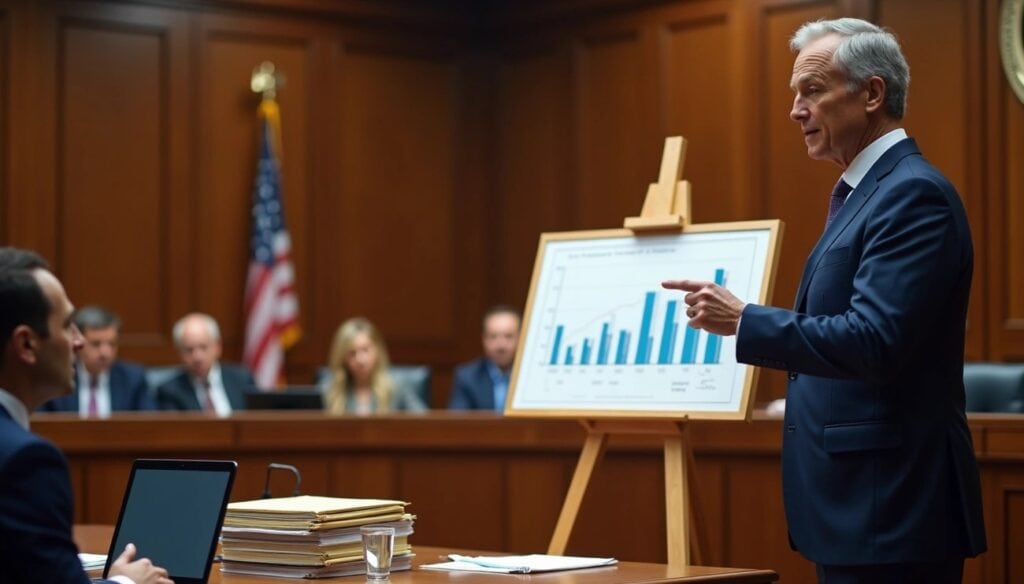
Well-prepared experts avoid jargon and focus on teachable concepts: (1) what would likely have happened absent the harmful event, (2) what actually happened, and (3) the difference after accounting for costs saved, mitigation, and timing. Common tools include demonstrative timelines, plain-English definitions, and step-by-step exhibits that let a juror reproduce the logic without needing specialized training.
Documents and Data Checklist
Economic damages testimony usually becomes stronger (and more efficient) when the following items are organized early:
• Pleadings and key liability allegations (to define the damages theory and period)• Financial statements and general ledger detail (monthly detail is often more useful than annual summaries)• Tax returns and payroll records (to corroborate revenue, wages, owner compensation, and benefits)• Sales data by product/service, customer, or location (to test for concentration and causation)• Contracts, pricing, invoices, and purchase orders (to quantify volume, pricing, and performance milestones)• Budgets, forecasts, and board/management communications supporting projections (and when they were created)• Industry benchmarks and macro indicators relevant to the business (to support “but-for” assumptions)• Mitigation documentation (job searches, replacement vendors, substitute products, cost-reduction steps)• Insurance claims, adjuster correspondence, and repair/restoration records (for interruption cases)• Prior expert reports, valuation workpapers, or internal analyses touching the claimed loss
Pitfalls, Common Errors, and Rebuttal Strategies
Opposing experts often focus less on the arithmetic and more on whether the inputs are justified. Below are common failure points and the most practical ways a damages expert typically addresses them.
Pitfall 1: Damages period creep
What goes wrong: the model assumes the loss lasted longer than the evidence supports.Rebuttal strategy: anchor the start and end dates to specific events (termination date, shutdown period, contract term, restoration date) and show alternative end points with the impact quantified.
Pitfall 2: Overstated “but-for” growth
What goes wrong: the model assumes aggressive growth or margins inconsistent with the business’s history or market conditions.Rebuttal strategy: tie growth/margin assumptions to historical performance, pipeline evidence, and third-party benchmarks; present conservative and midpoint scenarios and explain why the selected scenario is reasonable.
Pitfall 3: Failing to isolate causation
What goes wrong: declines caused by broader market conditions, seasonality, competition, or operational issues are attributed to the alleged wrongful act.Rebuttal strategy: use segmented data (by product, customer cohort, geography, or time period) and comparative benchmarks to separate event-driven impacts from unrelated trends.
Pitfall 4: Weak mitigation analysis
What goes wrong: the opposing side argues the plaintiff could have reduced loss through reasonable steps (replacement suppliers, substitute products, alternative employment).Rebuttal strategy: document mitigation efforts and incorporate mitigation impacts transparently (for example, offsetting replacement income or substitute sales) rather than ignoring them.
Pitfall 5: Discount rate and present value confusion
What goes wrong: discounting is applied inconsistently, or the expert cannot explain why a rate was chosen.Rebuttal strategy: show the rate’s components at a high level (risk-free baseline + risk adjustments) and provide sensitivity ranges so the jury sees the conclusion is not “engineered” around a single rate.
Pitfall 6: Report-to-testimony mismatch
What goes wrong: the report contains dense technical language, but testimony is improvised and inconsistent.Rebuttal strategy: map testimony to a small set of repeatable exhibits (timeline, key assumptions table, calculation walk-through, sensitivity table) and rehearse answering the same questions in the same way.
FAQs
What should counsel provide to the economic damages expert first?
A concise liability timeline, the damages theory being asserted, and the key documents that define the damages period (contracts, termination notices, shutdown dates) typically come first—then the financial records needed to quantify the loss.
How does an expert stay objective while still being persuasive to a jury?
By grounding every key assumption in evidence, showing reasonable alternatives, and explaining the model step-by-step. Objectivity is often the most persuasive feature because it limits what cross-examination can credibly attack.
What is the biggest cross-examination risk in an economic damages case?
Unsupported assumptions. Growth rates, margins, discount rates, and mitigation are frequent targets, so the expert should be prepared with documentation, benchmarks, and sensitivity analyses.
Do damages experts need to use a single “correct” method?
Not always. The method should fit the theory and the data. In many matters, experts use more than one approach as a reasonableness check and explain why one method is most reliable for the facts.
How early should testimony preparation start?
Ideally before expert reports are finalized. Early coordination reduces rework, allows targeted discovery requests, and improves the clarity of exhibits that may ultimately be used at deposition or trial.
What deliverables help a jury understand the numbers fastest?
A one-page assumptions summary, a timeline of key events, a simple calculation walk-through, and a sensitivity table showing how the conclusion changes under reasonable alternatives typically have the most impact.
Sources
• Federal Rules of Evidence (Rule 702) — Cornell Law School Legal Information Institute
• Federal Judicial Center — Reference Manual on Scientific Evidence (general guidance on expert evidence)
• AICPA — Standards and guidance relevant to valuation and litigation support engagements
• National Association of Forensic Economics (NAFE) — practitioner resources and professional context
CTA + Disclaimer
Contact the team at Joey Friedman CPA PA to discuss your expert witness services needs.
Disclaimer: This article is for informational purposes only and does not constitute legal advice. Outcomes depend on specific facts and circumstances.
Florida Counties — Forensic Accounting and Business Valuation Hubs
Joey Friedman CPA PA serves clients throughout Florida. For county-specific forensic accounting and business valuation engagement details, see:
- Miami-Dade County Forensic Accounting (11th Judicial Circuit)
- Broward County Forensic Accounting (17th Judicial Circuit — Mr. Friedman’s home county)
- Palm Beach County Forensic Accounting (15th Judicial Circuit)
- Orange County (Orlando) Forensic Accounting (9th Judicial Circuit + US Middle District Orlando Division)
- Hillsborough County (Tampa) Forensic Accounting (13th Judicial Circuit + US Middle District Tampa Division)
- Pinellas County (St. Petersburg / Clearwater) Forensic Accounting (6th Judicial Circuit + US Middle District Tampa Division)
- Duval County (Jacksonville) Forensic Accounting (4th Judicial Circuit + US Middle District Jacksonville Division)
- Lee County (Fort Myers) Forensic Accounting (20th Judicial Circuit + US Middle District Fort Myers Division)
- Collier County (Naples) Forensic Accounting (20th Judicial Circuit + US Middle District Fort Myers Division)
Regional and out-of-state hubs: South Florida Forensic Accounting and Business Valuation (Miami-Dade, Broward and Palm Beach counties) · New Jersey Forensic Accounting and Business Valuation.